CASE STUDY
AI-assisted software migration, up to 4x faster than traditional rewrites
A major e-commerce platform needed to modernize its legacy ASP.NET infrastructure without risking years of costly redevelopment. Using artificial intelligence and machine learning, our team accelerated the migration to PHP — reducing engineering effort, preserving business logic, and enabling the client to modernize their platform significantly faster than any traditional rewrite could.
Tech stack/tools we used: ASP.NET, Microsoft SQL Server, Legacy COM components, PHP, MS SQL Server, GitHub Copilot, Claude Sonnet, internal AI-assisted engineering workflows
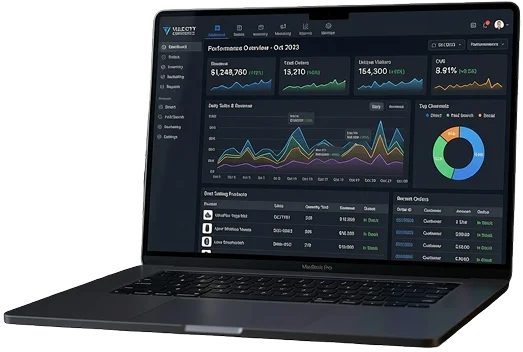
Client
Large-scale e-commerce platform operator (technology company)
Our client operated a large-scale e-commerce platform originally built on Classic ASP and ASP.NET — a codebase developed over many years using Microsoft technologies and tightly integrated COM-based components. The result: expensive maintenance, hard ceilings on scalability, outdated user experiences, and a development workflow increasingly out of step with modern standards.
A full rebuild from scratch was off the table. The platform carried years of embedded business logic that couldn't be lost, and the cost and risk of a ground-up rewrite made it a non-starter. The client needed a way to modernize without starting over.
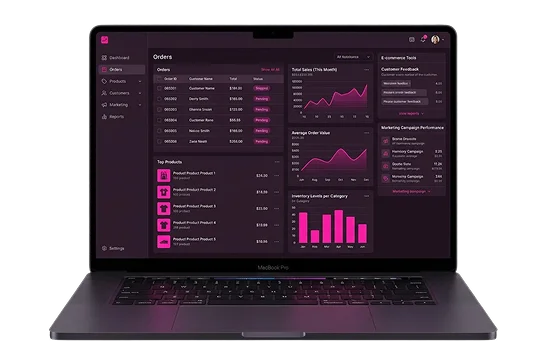
Problem
A Legacy Codebase Blocking Growth
The platform faced several interconnected technical challenges that made conventional migration strategies impractical:
- Legacy Technology Stack and Dependencies. The system relied heavily on ASP.NET and COM components — a tightly coupled architecture that limited flexibility, raised maintenance costs, and created deep dependencies between application layers. Moving lines of code of the system required understanding a web of interdependencies that were rarely documented.
- Mixed Code Complexity. Individual pages in the codebase combined HTML, VBScript, SQL, JavaScript, and COM-based business logic. This mixed-syntax environment made automated migration difficult without a structured preprocessing and decomposition approach. A naive code conversion pass would produce broken or unreliable outputs.
- Scalability Limitations. The legacy architecture slowed development cycles, limited automation, and made it increasingly difficult to compete with modern SaaS e-commerce solutions. New features took longer to ship. Performance bottlenecks were harder to resolve. The platform's architecture was limiting, not enabling, growth.
- High Cost and Risk of Manual Rewrites. A fully manual rewrite of the platform would have required years of engineering effort, carried significant operational risk, and offered no guarantee of functional equivalence with the original system. Traditional approaches to large-scale code migration are notoriously time-consuming and prone to introducing regression defects at scale.
Read more

Solution
AI-Augmented Engineering Workflows
Our team implemented an end-to-end AI-assisted modernization program designed to accelerate the migration process while maintaining system stability and preserving existing business logic. Rather than rebuilding the application from scratch, we combined AI-powered code transformation with expert developer oversight — a human-in-the-loop model optimizing for both speed and quality.
This approach reflects emerging best practices in enterprise AI and software engineering: AI agents handle the high-volume, repetitive work of code conversion; human engineers own validation, edge-case resolution, and architectural decisions.
Result
3x
faster migration speed compared to traditional manual code rewriting
~65%
reduction in engineering effort enabled by AI-assisted development workflows
97%
functional equivalence achieved validated through iterative testing and review
Challenge #1
Proof of Concept
(3 Months)
The initial phase focused on validating whether AI-assisted code transformation could be safely and effectively applied to a large legacy system. We selected a representative subset of the platform's codebase and tested our AI-driven migration workflow end-to-end, evaluating:
- Functional equivalence between ASP.NET source and PHP outputs
- LLM performance on decomposed code files vs. large, unprocessed inputs
- Validation and automated testing frameworks for regression detection
- The accuracy and reliability of AI-generated code across mixed-syntax files
The PoC demonstrated that AI-supported engineering workflows could significantly accelerate migration while maintaining system functionality. This gave the client the confidence to proceed with a full-scale engagement.
Challenge #2
Full Migration Program (1-Year Engagement)
Following the successful PoC, the project expanded into a full modernization program. The core workflow combined:
- AI-assisted code transformation using GitHub Copilot and Claude Sonnet to handle code conversion at scale
- Structured engineering workflows that decomposed complex, mixed-syntax files into processable units before AI conversion
- Automated and manual validation at each stage to ensure functional equivalence and data integrity
- Continuous developer review to catch AI-generated errors, handle edge cases, and maintain code quality
- Refactoring passes to align outputs with modern PHP conventions and platform architecture
This hybrid model significantly reduced manual effort while ensuring that the resulting system maintained the behavior and reliability required for a production e-commerce platform. Crucially, the migration preserved all existing business logic, avoiding the risk of inadvertently removing functionality embedded over years of development.
Succeed faster with Syberry
If you submit a request today, your MVP will be ready
as early as March 7, 2027
Key features
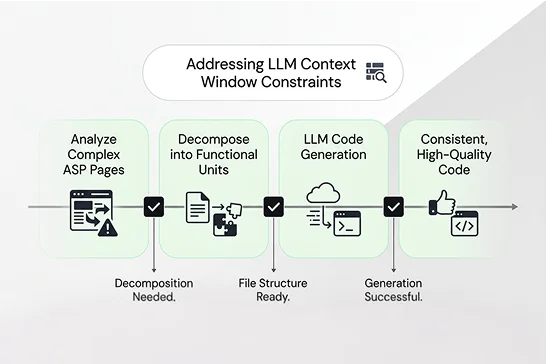
LLM Context Window Constraints
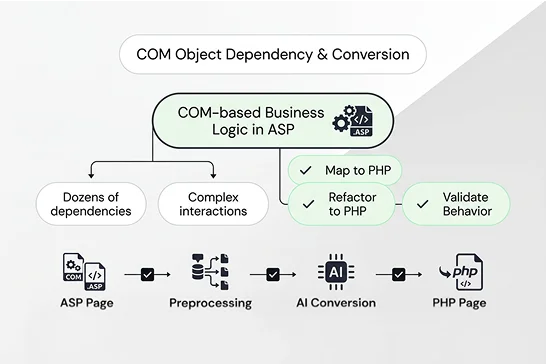
Large language models cannot reliably process very large code files in a single pass. Feeding an oversized codebase segment into an AI model produces inconsistent, unreliable outputs. Our solution was systematic file decomposition: breaking complex, tightly coupled ASP pages into smaller functional units before conversion. This preprocessing step was essential for consistent, high-quality AI-generated code.
COM Object Dependencies
The system relied heavily on COM objects integrated into ASP logic, making direct conversion non-trivial. We mapped COM-based business logic during the preprocessing phase and developed structured prompting strategies to guide the AI models through accurate PHP equivalents. This required deep domain knowledge from our engineers to validate that AI outputs preserved the intended behavior.
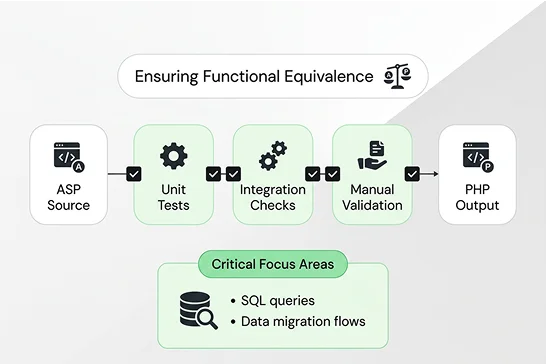
Managing AI-Generated Code Quality
Maintaining exact behavior parity between the ASP source and PHP outputs required rigorous automated testing at every stage of the migration lifecycle. We implemented unit tests, integration checks, and manual validation workflows to catch discrepancies before they reached production. Automated testing was especially critical for SQL queries and data migration flows where subtle differences could affect data integrity.
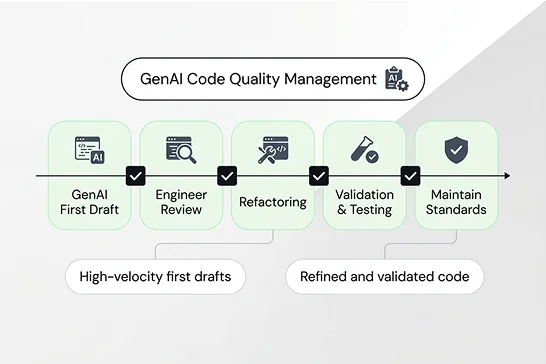
Managing AI-Generated Code Quality
Generative AI requires human-in-the-loop oversight: a principle we built into the workflow from day one. Engineers reviewed all genAI outputs, refactored where needed, and maintained strict quality standards throughout. Rather than treating AI-generated code as a final output, we treated it as a high-velocity first draft that engineers then refined and validated.
The outcome
AI-assisted workflows allowed the project to progress 3–4x faster than a traditional manual rewrite.

4x Faster Migration
AI-assisted workflows accelerated the entire migration lifecycle compared to traditional manual code rewrites.

Significant Cost Reduction
Reduced overall engineering effort and avoided the expense of rebuilding the platform from scratch.

Zero Business Disruption
Preserved existing business logic and platform functionality throughout the migration process, reducing downtime.

Improved Dev Velocity
The modernized stack enables the client's team to ship features faster and maintain the platform with less overhead.

AI-Augmented Engineering Model
The project demonstrated how AI can augment engineering teams to modernize large legacy systems and streamline the process in significantly less time.
- 4x Faster Migration. AI-assisted workflows accelerated the entire migration lifecycle compared to traditional manual code rewrites.
- Significant Cost Reduction. Reduced overall engineering effort and avoided the expense of rebuilding the platform from scratch.
- Zero Business Disruption. Preserved existing business logic and platform functionality throughout the migration process, reducing downtime.
- Improved Dev Velocity. The modernized stack enables the client's team to ship features faster and maintain the platform with less overhead.
- AI-Augmented Engineering Model. The project demonstrated how AI can augment engineering teams to modernize large legacy systems and streamline the process in significantly less time.
YOU MIGHT ALSO BE INTERESTED IN...
 ERP system for a plumbing business
Construction
ERP system for a plumbing business
Discover how a custom ERP solution made this company stand out from competitors.
 Electronic medical record solution
Healthcare
Electronic medical record solution
Custom software let this healthcare provider conveniently manage patient data.
 Mobile app for vehicle sales on the move
Automotive
Mobile app for vehicle sales on the move
Our client, one of the top vehicle manufacturers in the United States, has traditionally used a web application to enable sales reps to identify high-potential clients, close deals, and document interactions. This application has worked well… when reps are at their desks in their offices. How we helped a leading US automaker empower sales teams in the field.
 AI-driven trading platform for a FinTech giant
Finance
AI-driven trading platform for a FinTech giant
Discover how we helped this business speed up and improve their custom software.
Industries we work in








Succeed faster with Syberry
If you submit a request today, your MVP will be ready
as early as March 7, 2027